Is Crypto Staking Halal? Riba, Gambling and When Staking Is Allowed
The rise of cryptocurrency has sparked numerous innovations in the digital finance world, including staking, a key method for earning passive income in blockchain ecosystems. Staking allows crypto asset holders to lock their assets to support network operations, such as transaction validation, in exchange for rewards. However, for Muslims in Malaysia, a critical question arises: does staking comply with Shariah principles?
This article explains what staking is and how it works, then gives sharlife's Shariah perspective. It also answers the questions Muslim investors ask most often: whether staking involves riba, whether it is the same as gambling, when staking is allowed, and how to check a staking asset before you commit.
Short answer: based on sharlife's evaluation of staking's general structure, staking is deemed permissible (halal) under Shariah for technology-based digital assets that are not classified as ribawi. The reasoning, and the points to check, are explained below.
What Is Staking?
Staking refers to the process where cryptocurrency holders lock a portion of their assets in a digital wallet to support blockchain network operations. Examples include holders of Ethereum (after its Proof-of-Stake transition), Solana and Cardano. In return, they receive rewards in the form of new coins or transaction fees.
Staking is an alternative to mining in Proof-of-Work systems, which require high energy consumption. Proof-of-Stake (PoS) and Delegated Proof-of-Stake (DPoS) systems rely on staking, where validators are chosen to verify blocks based on the amount of crypto staked. This makes staking more environmentally friendly and efficient, and a popular choice in modern blockchain ecosystems.
Proof of Stake (PoS)
In PoS blockchains, creating and validating new blocks is called forging or minting. The PoS algorithm selects validators from a pool of crypto holders who have staked their assets. The more crypto staked, the higher the chance of being selected as a validator. Examples include Ethereum (ETH), Cardano (ADA) and Solana (SOL).
Delegated Proof of Stake (DPoS)
DPoS is an evolution of PoS, introducing a democratic element where stakeholders elect delegates to validate and forge blocks. This system is designed to be more efficient and scalable, requiring fewer validators. Examples include EOS (EOS) and TRON (TRX).
In summary, staking involves two key elements:
- Asset locking: Owners lock their coins for a specific period, either flexibly or fixed.
- Rewards: Rewards are distributed based on the staked amount, lock-up period and the network's consensus algorithm.
How Does Staking Work?
Staking operates within blockchains using the Proof-of-Stake (PoS) consensus mechanism. Below are the basic steps of how staking functions:
- Asset locking: Crypto holders lock a certain amount of coins in a compatible digital wallet for a specific blockchain protocol. For example, in Ethereum 2.0, a minimum of 32 ETH is required to become a full validator, though staking pools allow participation with smaller amounts.
- Network role: Locked assets support blockchain operations, such as validating transactions or creating new blocks. Validators are randomly selected based on the amount staked and other factors, like lock-up duration.
- Rewards and risks: Participants receive rewards in the form of additional coins or transaction fees. In Islamic finance terms, these rewards are comparable to dividends on investment accounts, hibah on qard savings accounts, or profits from tawarruq fixed deposit accounts. However, risks include slashing (penalties for validator technical failures) or losses due to crypto price volatility.
- Flexibility: Some platforms allow flexible staking (assets can be withdrawn anytime), while others require locking for a fixed period.
This process requires technical understanding and readiness to accept market risks, which are key points in the Shariah perspective.
Is Staking Halal? A Shariah Perspective
Before discussing staking, it is important to note that Islamic scholars and Shariah regulatory bodies, such as the Shariah Advisory Council of the Securities Commission Malaysia (SAC SC), recognise digital assets or cryptocurrencies as mal (property with value) under the Shariah perspective.
At its 233rd (29 June 2020) and 234th (20 July 2020) meetings, the SAC SC distinguished between two types of digital assets:
- Technology-based assets, such as Bitcoin (BTC), Ethereum (ETH) and Solana (SOL).
- Ribawi-based assets, such as gold, silver and fiat currencies.
This Shariah analysis focuses on technology-based crypto assets, which are not considered currencies. Therefore, the rules of bay' al-sarf (currency exchange) do not apply.
Shariah Analysis of Staking Structure
In staking, crypto holders lock their assets to support transaction validation in a blockchain, receiving rewards in return. Two primary Shariah contracts can be used to understand this structure.
1. Musyarakah (Partnership)
According to the Bank Negara Malaysia (BNM) Policy Document (2015) and AAOIFI, musyarakah is a partnership where two or more parties contribute capital and share profits and losses.
In staking:
- Crypto holders and validators pool their crypto to be selected as validators.
- If selected, they receive rewards (typically new coins or transaction fees).
- Rewards are distributed based on an agreed-upon ratio.
For exchange platforms like Binance or Coinbase:
- They may charge fees (e.g., 10% on Binance, up to 35% on Coinbase). Fees differ between platforms and can change, so always check the platform's current terms.
- This can be structured as:
- Ijarah al-a'mal (service fees),
- Ju'alah (rewards for achieving results), or
- Musyarakah if they share profits and bear some losses.
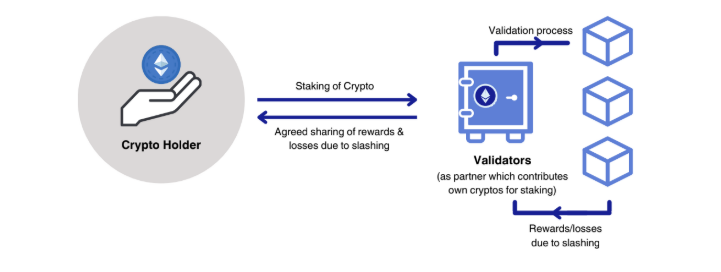
On the issue of contributing crypto rather than cash to the partnership in the staking process, both the BNM Policy Document and AAOIFI Shariah Standard No. 12 allow the capital contributed to be in kind, or in the form of commodities or labour, which makes the Shariah contract suitable as the basis of the transaction.
2. Mudarabah (Investment Partnership)
Mudarabah is a contract between the rabbul mal (capital provider) and the mudarib (manager). Profits are shared, but losses (not due to negligence) are borne solely by the rabbul mal.
In staking:
- Crypto holders are the rabbul mal, providing capital.
- Validators are the mudarib, performing validation tasks.
- Rewards are shared based on an agreed ratio, while losses (e.g., slashing or downtime) are borne by the crypto holder.
For exchange platforms:
- They can act as rabbul mal if they provide capital.
- They can act as mudarib, sharing rewards with validators.
- Alternatively, they may only charge service fees (ijarah or ju'alah).
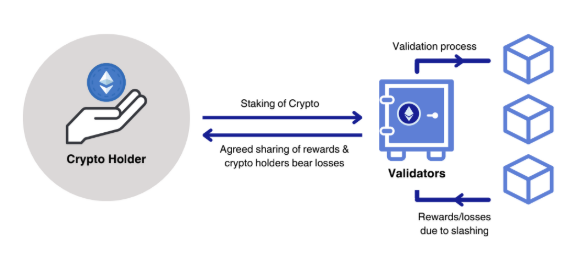
On capital contribution, BNM allows in-kind capital, even intangible assets, and AAOIFI permits tangible non-cash assets. Thus, there is no issue with using crypto as capital in a mudarabah venture.
Does Staking Involve Riba?
Riba is one of the main concerns Muslim investors raise about staking, because staking rewards can look similar to interest at first glance. Sharlife's analysis addresses this in three ways:
- The asset is not ribawi. Following the SAC SC distinction above, technology-based crypto assets such as BTC, ETH and SOL are not ribawi-based assets like gold, silver or fiat currencies, and are not considered currencies. The rules of bay' al-sarf therefore do not apply to them.
- Rewards come from network work, not from a loan. Staked assets are used to support transaction validation and block creation. Rewards are paid for that role, in the form of new coins or transaction fees, and can be understood through musyarakah, mudarabah, ijarah al-a'mal or ju'alah structures.
- The holder carries real risk. Under the mudarabah view, losses such as slashing or downtime are borne by the crypto holder, and the value of the staked coins moves with the market. This risk-sharing is what distinguishes the arrangement from a guaranteed return on a loan.
On this basis, the analysis finds no clear violation of the prohibition of riba for staking technology-based digital assets that are not classified as ribawi.
Note that this analysis covers staking as described in this article: locking assets to support validation on a PoS or DPoS network. Products that work differently, even if a platform markets them alongside staking, fall outside this analysis and should be understood on their own terms before you use them.
Is Staking the Same as Gambling?
Some investors worry that staking is a form of maysir (gambling), because validator selection involves an element of chance and rewards are not fixed. Sharlife's analysis does not treat staking as gambling, for these reasons:
- Rewards are earned through a service. Staked assets do real work on the network by securing it and validating transactions. Rewards are compensation for that contribution, not winnings from a bet.
- Selection follows set network rules. Validators are chosen according to the network's consensus algorithm, based on the amount staked and other factors such as lock-up duration. This is a mechanism for running the network, not a wager placed between parties.
- Risks are business risks. Slashing and price volatility are risks attached to participating in a productive activity, similar to the profit-and-loss sharing found in musyarakah and mudarabah. In gambling, one party's gain comes directly from another party's loss.
As concluded below, staking shows no clear violation of Shariah principles in avoiding maysir or gharar (excessive uncertainty), especially for technology-based digital assets. Understanding the risks before staking is still essential.
| Point | Staking (as analysed here) | Gambling (maysir) |
|---|---|---|
| Source of return | Rewards for supporting validation and block creation | Winnings taken from other participants' losses |
| Role of the participant | Contributes capital to network operations | Places a wager on an outcome |
| Nature of risk | Slashing, downtime and market volatility linked to a productive activity | Loss of the stake by chance, with no productive activity |
| Shariah contract lens | Musyarakah, mudarabah, ijarah al-a'mal or ju'alah | None |
When Is Crypto Staking Allowed?
Sharlife's conclusion is based on the general structure of staking. In practice, that conclusion fits your staking best when the following points hold:
- The coin is a technology-based asset. The analysis applies to technology-based digital assets that are not classified as ribawi (unlike gold, silver or fiat currencies).
- The coin itself passes Shariah screening. Staking does not change the status of the underlying coin. Check the coin on the sharlife crypto Shariah screener before staking it.
- Rewards come from network validation. Your assets are used to support transaction validation and block creation on a PoS or DPoS network, and rewards come as new coins or transaction fees.
- The roles and fees are clear. You know whether you are staking directly with a validator or through a platform, and what fee or reward share the platform or validator takes. This lets the arrangement be understood as musyarakah, mudarabah, ijarah or ju'alah.
- You understand and accept the risks. This includes slashing, downtime, lock-up periods and price volatility.
Explicitly adopting Shariah contract structures in staking offerings is encouraged, to bring transparency and fairness to roles, reward distribution and the handling of risk or negligence.
How to Check a Staking Asset
Before you stake any coin, work through these steps:
- Screen the coin. Search for the coin on sharlife's crypto Shariah page to see its current screening status. If the coin itself is not Shariah-compliant, staking it does not make it so.
- Confirm how the network works. Check that the coin uses Proof of Stake or Delegated Proof of Stake, and that staking means locking assets to support validation. Examples covered in this article include ETH, ADA and SOL (PoS) and EOS and TRX (DPoS).
- Decide how you will stake. You can stake directly with a validator, join a staking pool (useful when, for example, you hold less than the 32 ETH needed to be a full Ethereum validator), or stake through an exchange platform.
- Read the fee and reward terms. Find out what share of rewards the platform or validator keeps. Fees vary between platforms and can change over time, so read the current terms rather than relying on old figures.
- Check the lock-up terms. Find out whether the staking is flexible (withdraw anytime) or fixed for a period, and how long withdrawals take.
- Understand the risks. Learn whether slashing applies, who bears losses from validator failures or downtime, and how price movements could affect the value of your staked coins.
- Ask if unsure. If a product's structure is unclear, seek guidance from a qualified Shariah adviser before committing your assets.
Conclusion from Shariah Analysis
Based on the evaluation of staking's general structure, staking is deemed permissible (halal) under Shariah, aligned with the fiqh principle:
"The default ruling for contracts and conditions is permissibility and validity."
Staking, whether done directly with validators or through platforms like Binance and Coinbase, shows no clear violation of Shariah principles, particularly in avoiding riba (usury), gharar (excessive uncertainty) and maysir (gambling), especially for technology-based digital assets not classified as ribawi (e.g., gold or fiat currencies).
Although Shariah contracts are not explicitly used in current staking offerings, fiqh principles emphasise:
"The ruling of a matter depends on its intent and substance, not merely its form or wording."
However, to build confidence and clarity for Muslim crypto holders, explicitly adopting Shariah contract structures is encouraged to ensure transparency and fairness in defining roles, reward distribution, and risk or negligence management.
Conclusion
Staking plays a vital role in the crypto ecosystem, serving as a source of passive income (rewards) while supporting blockchain network security and efficiency. As the industry matures, staking mechanisms will become more sophisticated, focusing on broader user participation and network stability.
For Muslim crypto holders interested in staking, it is crucial to thoroughly understand the staking process, the associated risks and rewards, and the relevant Shariah guidelines and requirements. Start by checking the Shariah status of the coin you plan to stake on the sharlife crypto Shariah screener.
